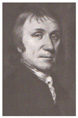
Joseph Priestley by Ellen Sharples
National Portrait Gallery, London
|
|
|
|
|
|
|
|
|
|
|
|
|
|
|
|
|
|
Joseph Priestley (1733-1804)
|
|
Joseph Priestley by Ellen Sharples National Portrait Gallery, London |
So, who was Joseph Priestley?
Joseph Priestley was born at Fieldhead near Leeds Yorkshire, England on 13th March 1733. He was the eldest of the six children of Jonas and Mary and was adopted by his aunt at the age of nine after his mother's death. It was there that he came under the influence of liberal thinking and theology.
He attended local schools and studied at the grammar school from 1745 where he learned Latin, Greek, Algebra, Physics, Maths and Philosophy. In 1755 he became minister at Needham Market Suffolk, after having spent four years at the Dissenting Academy at Daventry where he also developed an interest in physical science. In 1758 he went to Nantwich. Then in 1761 became a tutor at Warrington Academy in Lancashire. He married Mary Wilkinson in 1762 and was ordained that year.
What else did Joseph Priestley do?
In 1765, Priestley was awarded the degree of Doctor of Laws by the University of Edinburgh after publishing his Charts of Biography.
He was making visits to London around this time and became acquainted with Benjamin Franklin who encouraged Joseph Priestley to experiment with electricity. In 1767 he discovered that charcoal can conduct electricity.
Whilst a minister in Leeds, Priestley began his work on gases, which eventually in 1774 lead to the discovery of "dephlogisticated air" or oxygen (named by Lavoisier). Priestley also isolated and described the properties of several other gases including ammonia, nitrous oxide, sulphur dioxide and carbon monoxide. Prior to this in 1772, he developed the first carbonated (fizzy) drink.
In 1780, Joseph Priestley became a minister in Birmingham. He continued his scientific researches and also his theological ones. He expressed his views quite forcibly and in 1785, his History of the Corruptions of Christianity was publicly burned.
In 1791 Priestley was driven out of Birmingham by a mob who destroyed his home. He had expressed support for the French Revolution and so,on the second anniversary of the storming of the Bastille, the mob burned down his laboratory which was at his home.
From Birmingham, Priestley moved to London and then in 1794 moved to the United States of America. He remained there until his death at Northumberland Pennsylvania, on 6th February 1804.
